
This is an old revision of the document!
Raid Team Factors
All teams receive a score of Initiative, Attack and Protection.
The first team will act and lead its Attack, first by substracting to it the Protection points of the target team, then rolling the remaining Attack.
It will hope to “score hits”, which cause damage to enemy cards until it gets them down.
Equipment and Starship cannot be targeted: equipment cards for obvious reasons and Starship cards for behind too solid. They cannot be eliminated and are always active to determine the scores below.
Cards which can be targeted, such as Characters and Vehicles, contribute only while they have Combat Health left.
Once they have no Combat Health, they are removed from combat and cannot contribute the next time team values are estimated.
A team loses once it has no Character of Vehicle with Combat Health left.
Initiative
Every team will first compare its Initiative value; the best team will fire first in current battle round!
The worst team will first apply its damage (and casualties!), then estimate its attack from its remaining cards, and shoot back.
Then another round will begin.
It is thus an extreme advantage to fire first but mostly if you can take out some cards before they can shoot back.
On the first round of a battle, Initiative is given by estimating the capacity in Stealth (*2) and Awareness of all your team cards.
In later rounds in a battle, your group will react to an ongoing combat instead of their starting positions, and Initiative is given by estimating capacity in:
Speed (*2) and Tactical Orders (*2) of all team cards.
Your total Initiative value is given by estimating these traits exactly the same way we do it in normal challenges:
Taking traits one by one, every card contributes “one dice” every 3 full matching Power points the card has in these traits.
For example, if you have 11 Stealth Power and 9 Awareness Power on a card, your card itself will contribute 3 rolls to Initiative for its Stealth and 3 more for its Awareness.
Once we have the number of total dice for your team, these dice are rolled to determine your value. For Initiative, the score to beat is 3+ on individual dice.
The entire process is invisible for all players and only reports the resulting Initiative.
You can however determine how helpful an individual card is by looking at the tooltip of a character.
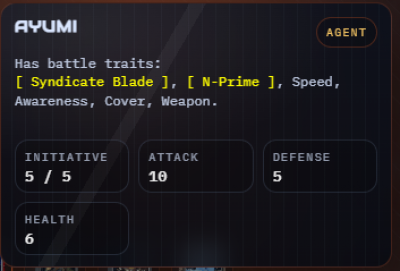
The first value is the starting Initiative, and the second value the Initiative for subsequent rounds.
Scout Teams
Scout teams always have +2 in their Initiative.
In addition, Scout teams can have an AMBUSH advantage. This bonus triggers if they come to an unexplored sector, meaning if no one controls this sector when assigning teams.
They will be able to map this sector and take positions quickly, giving them +30 Initiative in the first round of combat.
Attack
Attack capacity is determined by estimating:
Orders, Leadership, Shooting (*2) and Weapon (*2) of all team cards.
This is done the same way we do for Challenges, against a value of 4+.
Strike Teams
Strike teams always get +1 in their Attack value.
Strike teams attacking “a sitting team” (a team that was already controlling a sector the week before) can “lead an Assault” against it. An Assault contributes one more instance of Tactical Orders and one more instance of Shooting to your dice.
Protection
Protection is used to reduce the Attack value of an enemy team before it fires at you.
Protection capacity is determined by estimating: Orders (*2) and Cover (*2).
Rolls are made against a value of 4+ to determine how many points you remove from an enemy Attack.
Hits
Before shooting, the attacking team determines its possible targets by aiming only at Characters and Vehicles (it cannot aim at Equipments, and won't aim at Starships).
Once you have a team remaining Attack value (after removing the Protection result), the attacking team will roll its attack dice.
A hit is done for every die having 4+ in its face value.
A hit will target a random card in the enemy team (only from cards which can be targeted, above).
It will cause 1 point of Damage to this card, which means it will remove 1 Combat Health from the card it hits.
This can lead to “overkill” if you strike it again during this round even if the card was knocked out.
Overkill allows an attribution of damage that can help “lower collections”: as superior shooting power is spent shooting someone who is dead already!